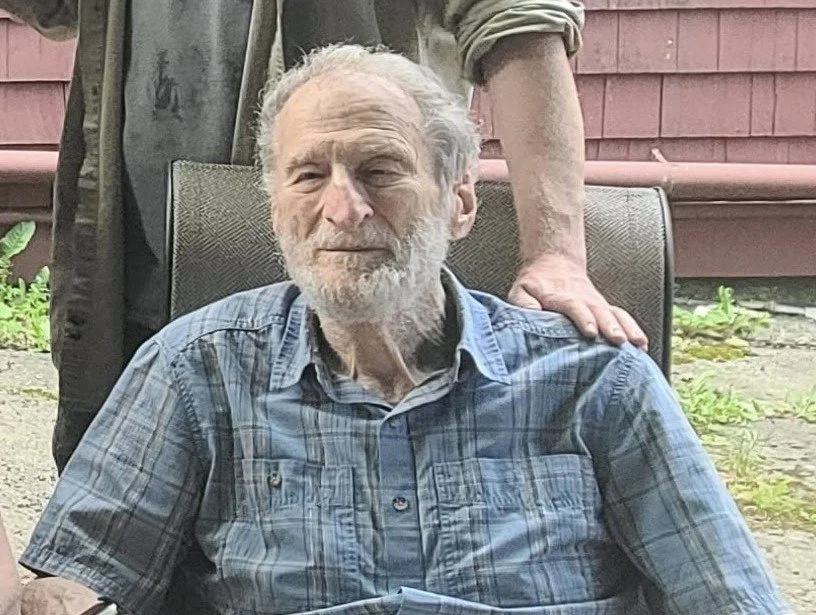
A Tribute to Herb Gamberg 1933-2025
by Larry Haiven
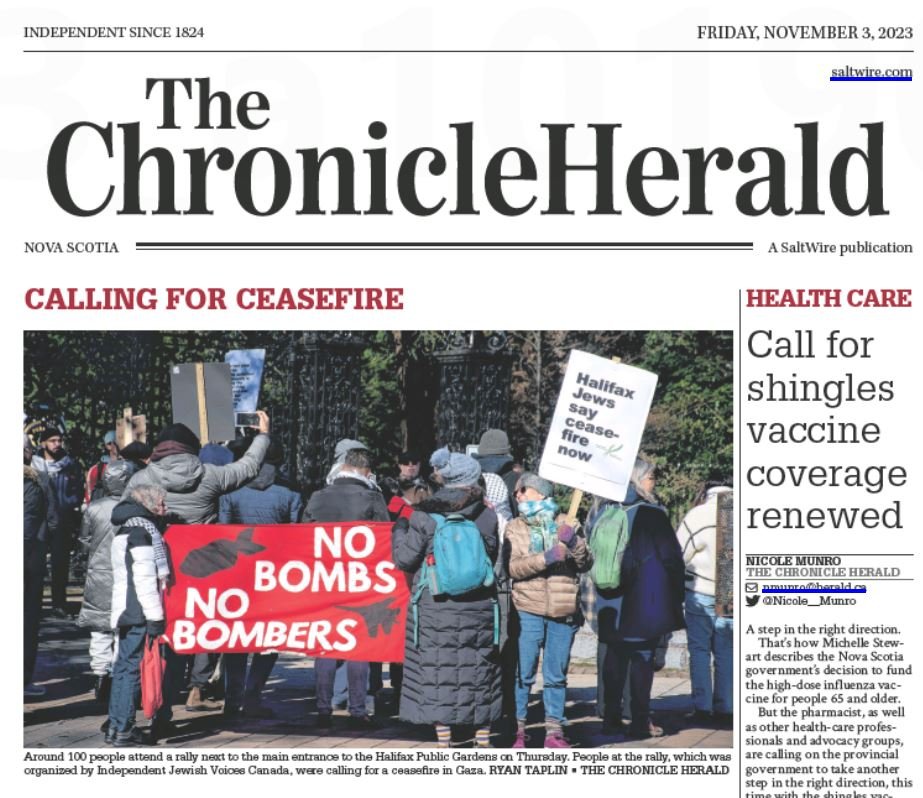
Herb Gamberg, a senior member of Independent Jewish Voices in Halifax and a much-respected left activist in that city, died on December 2, 2025. He was 92 years old. He leaves his wife Ruth, son Tony, grandson Nick, and many bereaved friends. Even at their advanced age, Herb and Ruth would turn out regularly at Halifax rallies against the Israeli genocide in Gaza with their IJV colleagues, as recently as October, 2025. A few months earlier, they helped celebrate the awarding of an honorary degree to Judy and me from the Atlantic School of Theology. They gave wise counsel from a lifetime of political activity.
I value Herb’s friendship greatly and I learned a lot from him. Still, as I talk to friends and family and read Herb’s own autobiographical notes, I see what I missed. I devoutly wish he were still around so we could talk about his life, something we regretfully don’t do enough in the hurley-burley. Few of us are aware of our importance to history. That’s why we need to share lives like Herb’s with one another, to better understand ourselves. I’ll talk about elements of his life and I’ll leave it to my son, Omri, further down in this piece, to discuss Herb’s unique character.
A retired professor of sociology at Dalhousie University in Halifax, Nova Scotia, Herb was born near the beginning of the Great Depression, in Worcester, Massachusetts, a small city of 200,000, with an outsized Jewish population of 13,000, many involved in the clothing industry. Not far away was Lawrence, Massachusetts, the scene of one of the most famous labour battles in US history, the so-called “Bread and Roses” (mostly women-led) strike of 1912, organized by the Industrial Workers of the World (IWW).
Herb’s parents, born in Eastern Europe at the turn of the 20th century, first came to New York City and met each other working in the rag trade. When much of the work moved to the surrounding New England, they moved with it. There they raised their four children (two girls and two boys).
While Herb’s mother grew up in an observant Orthodox Jewish family, his father’s upbringing and, indeed Herb’s, were largely secular. Yet his youth was steeped in the American Jewish community. Like many older IJV members, Herb and Ruth’s approach to Jewishness was strictly secular, political and instrumental (rather than spiritual), spurred by the injustice of Israel’s treatment of the Palestinians and the need to speak out as ethnic Jews.
Herb and Ruth married in 1956 and were together for 69 years. Ruth, formerly an Education professor at Dalhousie, is also from New England, but a much smaller town - Waterville, Maine. They met as undergraduate students at Brandeis University.
What a heady educational experience that was in the early ‘50s: a brand new college 20 km from Boston named after the first Jewish member of the US Supreme Court, a high proportion of Jewish students, and a faculty full of renowned intellectuals, including psychologist Abraham Maslow, political scientist Max Lerner, sociologists C. Wright Mills, Lewis Coser and Hans Gerth, musician Leonard Bernstein, critic Irving Howe and philosopher Herbert Marcuse. While most of these figures were decidedly on the left at the time, Herb claims that his interest in socialism came only much later; what he imbibed from these teachers was their critical intellectual approach, based more on Weber and Durkheim than on Marx and the Marxists. This may have been due to the anti-communist tenor of the early 50s. (Though Marcuse, originally a member of the Marxist Frankfurt School, became a beacon to young radicals of the 60s for his pioneering work on social control under capitalism.)
The Brandeis scholars, like many of that period, saw the US as the centre of the intellectual world, a phenomenon which Herb quotes Mills calling “the American celebration.”
For his post-graduate training, Herb started at the New School for Social Research in New York, another hotbed of intellectual fervour, but this time, more oriented to European traditions. This was also the place where Herb absorbed a life-long devotion to teaching about society through literature, for example, seeking to understand the sociology of mid19th century France by reading novelist Honoré de Balzac.
Realizing that the New School’s reputation in McCarthyite America might impede him from the academic career he desired, Herb moved to Princeton, part of one of the first cohorts in that institution to come from public, rather than private, schools. Despite the influx of the hoi polloi, Herb says, the place still “oozed with elitism.” He graduated with an MA and later wrote a dissertation to obtain his PhD.
Princeton’s sociology department was dominated by Harvard graduates, including Talcott Parsons, whose “structural functional” approach was all the rage in that subject for the better part of 30 years. Functionalism stressed societal harmony, interdependence, consensus and equilibrium. Concentrating on conflict was anathema to these mid-century American sociologists. Though Herb’s later academic and political focus was indeed on conflict, he was grateful to functionalism for stressing society-wide phenomena. He wanted to look at broad systemic questions, rather than the specific nuances of that systems' components.
Blessed with these credentials and working on his PhD dissertation, Herb began the typical American academic apprenticeship odyssey. He obtained a lecturer position at the University of Pennsylvania where he first established a reputation as a popular teacher. However, realizing that the “publish or perish” rule prevailed over pedagogical excellence, he bagged a research job financed by the Ford Foundation at the University of Illinois - Champaign/Urbana, another of the “Big Ten” US schools, studying the relationship of the university to its local community.
By then the advent of the 1960s and the thawing of the previous decade’s conservatism led Herb to begin a focus on social inequality, social class, the outsize role of business, and what used to be called the “Third World.”
Spurred by one of Herb’s Canadian colleagues who was returning to teach in Canada, Herb and Ruth, as many Americans in the 60s, looked to Canada as an alternative.
Ruth and I were fed up with American foreign policy in the Cuban Missile Crisis and the lack of any major response to the unjust American military engagement in Vietnam. The capstone event was a demonstration we had been involved in protesting the war in 1964. Only six people showed up on a Saturday as 60,000 people were streaming by us to a football game. We decided that we had had enough and going to Canada had an exotic ring to us.
The Gambergs were the first part of an influx to Canadian universities of American academics, later to reach torrent proportions at the end of the decade as the Vietnam War and the draft claimed young male bodies. In those days, academics from the US could be hired with barely a phone interview. By 1971 and the adoption of universal medicare, Canada became even more attractive a destination.
I must admit that, twenty years Herb’s junior, I cut my political teeth opposing that academic invasion of Canada. By the late ‘60s, Canadian universities were desperately seeking faculty to teach the legions of Canuck Baby Boomers then swelling the lecture halls. Problem was, the US migrants filled many positions that could have gone to Canadians. Many of the early Americans, ensconced in a position to hire, sought their own friends and grad students from stateside, making the situation worse. The bulk of these new professors had little or no allegiance to their new country; many, looking for the first opportunity to return to their land of birth, even refused to become Canadian citizens. I knew many American scholars in those early days who knew nothing about Canada and cared less, and who clearly thought they were part of a “civilizing mission” to bring American values to the northern backwoods, at least until they could, like prodigal children, go home.
Inspired by a heady left-wing anti-imperialism, I was head of the “85% Canadian Quota Campaign”, which sought to stop the American inundation or at least get them to become Canadian - by citizenship, interest and devotion. We also championed academics from countries other than the US.
I’m pleased to say that the Gambergs were of the few who never looked back for 60 years, adopting their new homeland with respect and interest. From the time of their arrival in Canada, Herb and Ruth set to building their institutions and seeking political solutions here.
As part of an early academic couple, Herb freely admits that he got the better of the deal as women scholars faced exploitation and abuse. Ruth not only taught more classes than Herb, she also supervised teacher practicums. Moreover, female members of academic couples did not receive paid sabbatical leaves, on the assumption that they would go with and be supported by their husbands. As Herb summarizes:
Bluntly put, Ruth was underpaid and overworked whereas I was in the opposite situation. I retired because I was obliged by rules to do so and Ruth retired because she was exhausted.
As well as helping start Dalhousie’s sociology department and teaching nearly every course in its curriculum, Herb was instrumental in establishing and teaching in the “Foundation Year Program” at the University of King’s College, a small liberal arts institution affiliated to Dalhousie. The FYP was a “literary humanities” program similar to the one at Columbia, wherein freshman students read the “great books” of Western civilization (which later became broader) and, with an Oxbridge seminar technique and plenty of reading and writing) emerged as much more serious scholars after one year than before. I know whereof I speak as my son Omri is an alumnus of the FYP.
It was only after arriving at Dalhousie that Herb and Ruth really got interested in Marx and Marxism. It was a heady time to be doing that, right at the beginning of a serious ideological split between China and the Soviet Union. Herb’s “mind was blown” by reading for the first time The Communist Manifesto and other works of the two authors in a newly-founded reading group.
When I discovered that it [the Manifesto] was written by two guys of 26 and 28 (I was 35 then) I wondered how much time I had wasted without any real introduction to the subject.
While Marxism deeply suffused his teaching, and though he was involved in left political struggles in Nova Scotia and Canada, Herb says he taught his first class strictly in Marxism only after his official retirement.
One of those who partook of Herb’s instruction in Marxism was my son, Omri, who has this to say about Herb. Omri’s comments also allude to those elements of Herb’s character that we all admired:
Herb was a warm and lively conversationalist who remained interested in young people and their thoughts despite his age, experience and rueful assessment of contemporary left formations.
He was a guest lecturer for a ‘Capital’ study group that was formed by King’s students that I was a part of during the summer of 2010. Rather than trying to control the discussion or impose his ideological penchants, Herb came across as principled but flexible in all the interactions I've had with him. His method was socratic and engaged with whoever he was talking with but most importantly, he actually seemed to listen to what people had to say!
Herb’s close reading of texts and love for new interpretations of old works led to a flexibility and curiosity you don’t see very often from men after a certain age.
Herb would humbly attend most rallies alongside Ruth and they would always have a warm and affable impact on the crowd in a way that felt both gentle and powerful.
Another facet of this gentle strength was Herbs’ ability to change his perspective as circumstances changed. While his assessment of the concrete conditions shifted, his stalwart defence for socialist ideals marked an inspiring through-line. Instead of letting his viewpoints ossify, Herb’s relationship with the Marxist canon and his praxis led to a relaxed confidence, rarely seen on the radical left.
To be sure, Ruth had some part in keeping Herb so sharp and yet compassionate for all these years. His sly humour will be with me for a long time.
There’s much to learn from Herb’s example and to appreciate about his happy warriorship.
When student radicalism exploded on campuses across the world in the late ‘60s, Dalhousie was no exception. Herb prefigured this rebellion when he was appointed department chair and promptly introduced democratic governance and invited students in on the decision-making. That produced a backlash in senior administration and he was never allowed by his higher-ups to be chair again.
In 1970, Herb and Ruth became involved, with the nascent “East Coast Socialist Movement”, in the so-called “Fishermen’s Strike” in three small villages in Nova Scotia. Though nominally independent harvesters, the strikers were totally under the thumb of large fish processing firms. Labeled “co-adventurers” by the labour relations board, they were not allowed to unionize and hence negotiate the price of their catch or the conditions of their servitude to power. The strike galvanized the Maritime left; for many it was their first labour struggle. It was here that the Gambergs met the legendary Communist Party organizer and fish union leader Homer Stevens, who had done so much to bring dignity to fish harvesters on Canada’s West Coast. The business class, politicians and media shamelessly red-baited Stevens, but Herb tells of one incident where “two women [from a fishing village] wrote a letter to the Halifax Chronicle Herald saying, ‘if Homer is a communist, then we are communists too.’”
While an inspiring struggle for the workers and their supporters, it did not succeed.
But it was also where Herb and Ruth learned sad lessons about left infantilism and performatism, where token pronouncements can be more important than patience and careful progress. The term “working class” became the formalist arbiter of legitimacy. Herb quotes the late writer Silver Donald Cameron who described many of the young middle-class comrades as “prolier than thou.”
Like many of the left groupings of the early 70s, the East Coast Socialist Movement quickly dissolved as an organization. Herb, Ruth and friends started the “Halifax Study Group.” Not long afterward, several Marxist organizations from Central Canada came calling to get the Halifax collective to “rally to” (join) their cause. Herb felt that, given their limited experience and a misreading of the political situation in Canada, these groups were overly pretentious in declaring a revolutionary situation in the country and forming themselves into Communist parties. As Herb writes: “I was strongly convinced by this time that the new left was not the progressive force it pretended to be. This understanding led me to write a critique of the new left called The New Infantilism. The Halifax collective declined to join. These Central Canadian groups soon split acrimoniously, while the Halifax Study Group continued until 1980.
It was also in the 70s that their interest in China peaked and they began a three decade-long engagement with that country, traveling, touring and teaching there, and communing with other Western “China hands” to explain China to the world through a “Canada-China Friendship Association.” It was only with China’s decisive turn toward capitalism in the late 20th century that that intense love affair ended.
Herb and Ruth were among the first people to join the Halifax chapter of Independent Jewish Voices in 2010, soon after the founding of the national organization. They both became friends with another early IJV adherent, Israeli expatriate and writer Zalman Amit. Zalman, also in his 90s, passed away a little more than a year ago. IJV Halifax was one of the more active small-city chapters in that organization, especially after the Gaza genocide began on 7 October, 2023.
While we were all shocked and horrified to witness the Israeli genocide, Herb and Ruth were firm that Jews had to speak out against Israel’s war on the Palestinians. They were gratified to see an bunch of younger Jews flocking to IJV Halifax, repeating a phenomenon seen across the country.
We will miss Herb dearly.